



Tenants' Union policy priorities
Introduction
Everyone has the right to a safe, stable and affordable home. Housing is the foundation for ensuring our communities’ wellbeing. Yet many renters in NSW face uncertainty, rising rents, poor housing conditions and barriers to making their rental property feel like home.
Our advocacy brings together the lived experience of renters, evidence from Tenant Advocates, research, data and policy expertise. We advocate for practical reforms that make renting fairer, safer and more secure.
We recognise that the people of NSW have the human right to adequate housing, which Australia has committed to as an international law obligation but not delivered. We support the implementation of a specific right and many of our priorities directly address the elements of the right to adequate housing.
NSW needs more homes in areas people want to live, at prices they can afford. The supply of new dwellings should treat current renters with care and avoid displacement from their communities.
Our priorities:
Our policy and advocacy work focuses on improving renting laws and housing policy to deliver:
Stable homes for all renters
- fairer renting laws, including greater security, fair rent regulation, stronger protections against unfair eviction and more freedom for renters to make a home
- safe, healthy and sustainable rental homes, including stronger standards for housing quality, energy efficiency and habitability
- better housing outcomes for renters experiencing disadvantage, including Aboriginal renters, low-income households, people with disability and older renters
Fairer rental system in NSW
- improved public, community and Aboriginal housing policy and practice, including improving the standard of homes and increasing the supply of homes
- finance and tax policies that support affordability, fairness and housing security.
- better protections for residents of residential land lease communities, including fair site fees and utility charges, safe communities and stronger accountability for operators
- stronger protections for renters in marginal housing, including share housing, boarding houses and other insecure accommodation
Our advocacy is informed by research, data analysis, submissions, consultations and the experiences of renters. Our work can be viewed here.
If you would like to keep updated, follow us on Facebook, LinkedIn, Instagram or contact us at contact@tenantsunion.org.au
1. Fairer laws about rent increases
Rent increases should be justifiable, predictable, transparent and fair.
- The issue
Rent increases are putting tenants under serious financial pressure.
Recent reforms limit rent increases to once every 12 months, but there is still no general limit on how much rent can be increased. In NSW, tenants can apply to the Tribunal if they believe a rent increase is excessive, but the burden is on the tenant to challenge the increase and provide evidence.
However, applying to the Tribunal can be difficult, stressful and time-consuming, especially for tenants already under financial strain, so when faced with an excessive rent increase, many renters are forced to leave their home.
Rent increases are now a common experience. By April 2025, almost three quarters of existing renters across Australia had experienced a rent increase in the previous year. A quarter had experienced an increase of more than 10%.
These increases are landing in a rental system where affordability is already stretched. In 2019–20, the median low-income renter household spent 36% of its income on rent, with 20% of this cohort spending more than 50% of income on rent. Furthermore, the proportion of low income households in rental stress (paying more than 30% of income on rent) increased from 47% in 2020 to 54% in 2023.
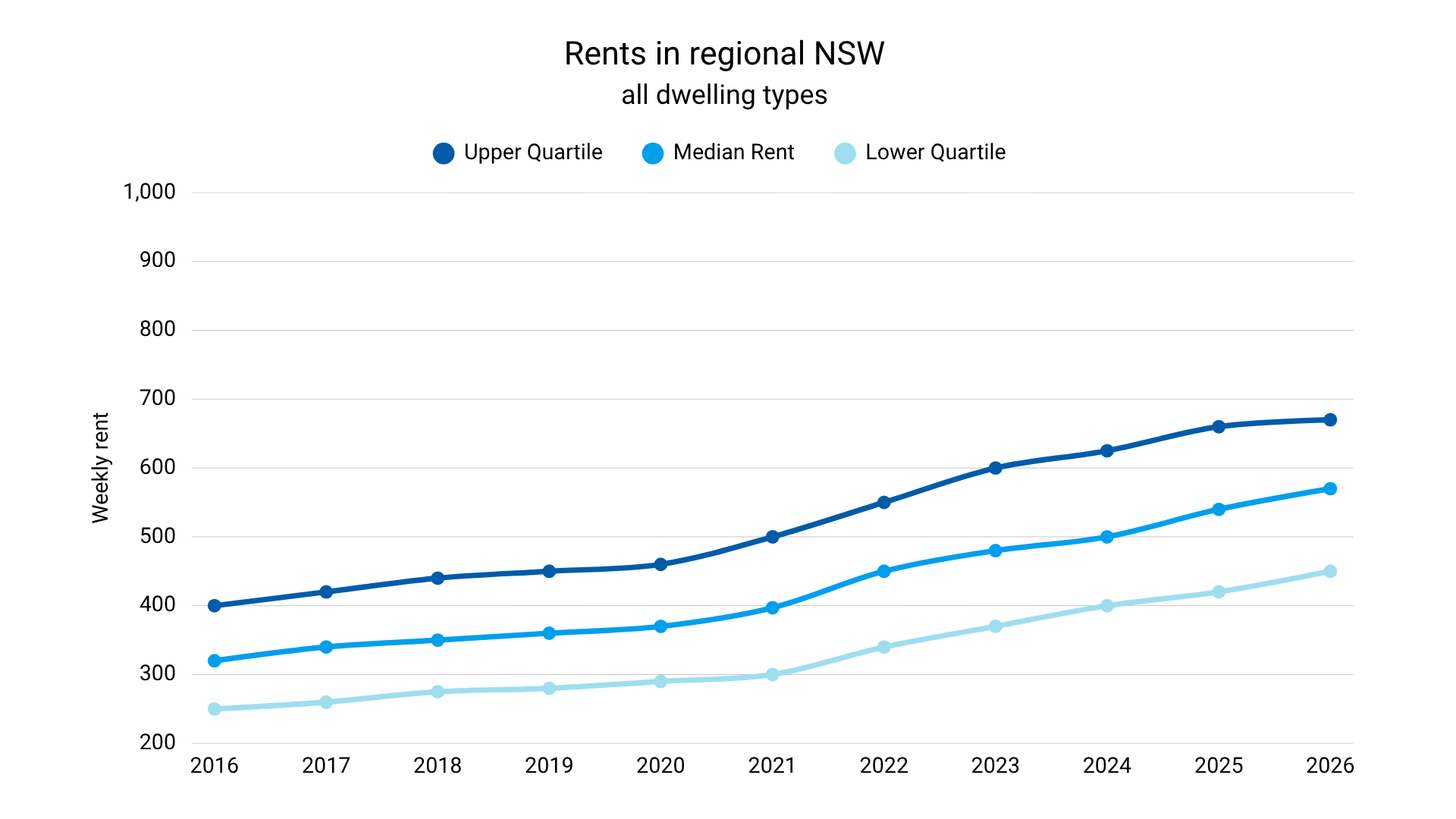
Asking rents for all dwelling types, Greater Sydney and regional NSW, 2016-26 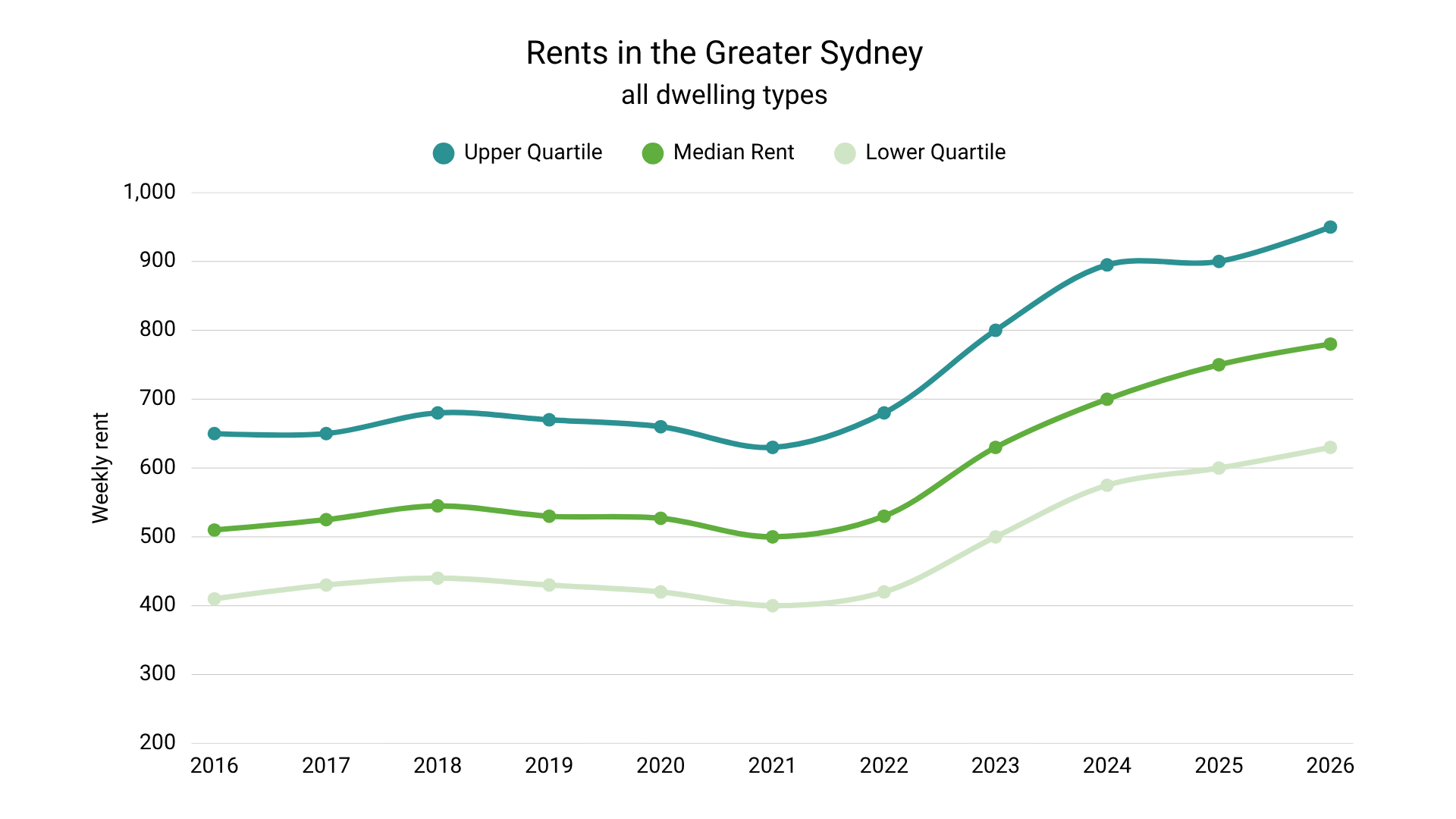
Even a modest rent increase can be hard to absorb, especially for tenants on low incomes. In a national survey of private renters, more than one in three said a 5% increase would be difficult or very difficult to afford.
Fair and predictable rent increase rules support the overall rental system by reducing risk and uncertainty.
- The solution
Affordable homes, fair rent increases.
Tenancy laws should place fair and reasonable guidance on rent increases during a tenancy and in between tenancies when there is a change of tenants. This could include:
- a fixed percentage cap on rent increases;
- limiting rent increases to the annual percentage change in the Consumer Price Index (CPI), ensuring rents rise in line with inflation and do not outpace broader cost-of-living pressures; or
- annual reviews of allowable rent increase thresholds by an independent arbitrator or pricing tribunal;
- requiring landlords to demonstrate that a rent increase is reasonable and not excessive where it exceeds 3%, reflecting the upper end of the Reserve Bank of Australia's inflation target band.
Each of these has trade-offs between simplicity, responsiveness to changing circumstances and broader economic conditions, practicality of implementation and likelihood of disputes.
The excessive rent increase dispute process must be made fairer. Where a rent increase is above a reasonable threshold, the landlord should be required to show that the increase is not excessive. Tenants should not have to carry the burden of proving that a large increase is unfair, but where even a small increase may not be justified because the property conditions are falling behind, it is reasonable for tenants to have the option to make that case.
In addition, there is currently no consideration of the tenants' circumstances when the Tribunal assesses whether a rent increase is excessive. Including tenants' circumstances in the Tribunal's decision-making process will provide a fairer and reasonable outcome for tenants when landlords are seeking a higher increase.
The Tenants’ Union supports
- introducing a 3% threshold on rent increases without tenant agreement or Tribunal review during tenancies;
- requiring landlords to demonstrate that a rent increase is reasonable and not excessive where they wish to increase the rent above the 3% threshold;
- introducing a 3% limit on rent increases between tenancies less than 12 months apart without approval from Fair Trading to allow for renovations or significant improvements;
- consideration of tenants' circumstances when determining excessive rent increase applications;
- ensure renters can continue to raise property conditions and other relevant factors as a consideration for all rent increases.
- Further reading
Reports
- Rights at risk rising rents and repercussions August 2025
- Regulating rents: international examples & experience November 2023
Resources
- Rent Tracker
- Rent Increases factsheet and other resources
- Rent Increase Negotiation Kit
You might also like:
- Rent Tracker Research Project
- New Laws on Rent Increases (NSW) (YouTube video)
- Rights at Risk: Rising Rents and Repercussions: The Experience of Renting in Australia. A collaboration of National Shelter, NARO, and the Australian Council of Social Service (ACOSS)/UNSW Sydney led Poverty and Inequality Partnership
2. Fairer laws about tenancy termination
Tenants should not lose their home unless termination is genuinely necessary, well-evidenced and fair.
- The issue
Recent reforms have improved security for tenants by ending no-grounds terminations in NSW. Landlords must now provide a valid legal reason to end a tenancy.
However, tenants can still face termination even when they have done nothing wrong, including in cases when a landlord or family member wants to move in, the landlord intends to put the property up for sale, or it has been sold, or significant renovations or repairs are planned. The prospect of termination on a wide range of prescribed grounds, all focused solely on the landlord's circumstances, makes renting insecure and undermines tenants’ rights.
For tenants, termination can mean much more than losing a tenancy. Around one third of people in NSW rent their homes, and the average renter in NSW moves every 18 months. In a tight and expensive rental market, being forced to move can bring significant cost and stress, and disrupt work, school, care, health and community connections.
Secure housing is about more than having a roof over your head. Avoidable evictions and forced moves can increase pressure on tenants and on homelessness, health, legal, financial counselling and community services.
- The solution
Secure homes, stronger rights.
Tenancy laws should support tenants to stay safely housed wherever possible, while still allowing a tenancy to end when termination is genuinely necessary.
Landlords should be required to provide strong evidence to support a termination notice. The Tribunal should be able to refuse the termination if it is not fair and reasonable, having regard to the circumstances of both parties and the hardship termination would cause.
A prescribed ground should not automatically mean that a tenancy must end. Where the reason for ending the tenancy can reasonably be addressed without the tenant moving out, termination should not be the default outcome. For example, a home can often be prepared for sale while the tenant remains in occupation, and repairs or renovations may be managed through a negotiated temporary move.
The Tenants’ Union supports
- limiting termination to circumstances where there is a genuine need to end the tenancy;
- encouraging fair negotiations to sustain tenancies;
- strong evidence requirements to support termination notices;
- greater discretion for the Tribunal to refuse termination where it is not fair and reasonable, having regard to the tenant’s circumstances and hardship;
- recognition of Aboriginal tenants’ cultural connection to Country when considering termination applications;
- reforms that reduce unnecessary displacement and support long-term housing stability.
- Further reading
Reports
- Listening to Renters' Voices: A report from the Renters' Forums hosted by the Tenants' Union of NSW, in partnership with the Sydney Alliance and NSW Fair Trading (April 2025).
- Two Year Performance Report on the progress of A Better Deal for Renters (September 2025)
- A constant worry: Renters confront the impact of unfair evictions (April 2024)
- Eviction, Hardship, and the Housing Crisis (February 2022)
Resources
- Eviction factsheets, sample letters and other resources
- Eviction notice checker - TUNSW
- Renters have rights (July 2025)
- New laws on evictions - TUNSW (YouTube)
You might also like
3. Social housing we are all proud of
Social housing should be a secure, permanent and affordable part of the housing system, giving people a stable home and a foundation for their lives.
- The issue
Governments, housing sector workers, researchers and commentators too often still discuss social housing as being something less than private rental despite being superior in every aspect - more affordable, more stable, with more transparent and accountable landlords. The problem is we do not value or support social housing for what it achieves and that creates problems for everyone.
There is not enough social housing for the people who need it.
You’ll have heard that the waitlist is large. Over the 12 months to 30 June 2026, between 65,000 and 70,000 households were waiting for social housing across NSW. In NSW the wait times for public housing currently range from between 2 and 10+ years across the state.
But waiting lists do not show the full scale of need. They do not capture everyone who is homeless, displaced by unaffordable housing, unable to apply, or discouraged from applying because the wait is too long. UNSW calculated that 220,000 households were in need of genuinely affordable housing in 2021 - three times as many households as on the waiting list.
The shortage of social housing has shaped the system. Public and community housing in NSW, and across Australia, has become increasingly residualised. This means it has been treated as housing of last resort, with narrow eligibility rules and policies that encourage tenants to leave as soon as possible, even where there are no secure or affordable alternatives.
This model weakens the sustainability of the system. When social housing is limited mainly to households on very low incomes or income support, rental income alone cannot fund the maintenance, renewal and expansion of the homes people need. It also means a big gap for people who had previously been eligible but were ruled out. Trying to rely on discounts to market in ‘Affordable Housing’ to fill this gap has created a messy and unsuccessful replacement. Affordable Housing homes are intended to meet the needs of very low, low and medium income households but while rents are set at a discount to market rent they are not affordable.
For some tenants, social housing can still feel fragile. Rent arrears, breach notices, antisocial behaviour allegations or other tenancy issues can quickly put their home at risk, even where the issue could be resolved with support.
Social housing providers use the Tribunal for eviction proceedings at much higher rates than private landlords, including in rent arrears matters. Tribunal proceedings should not be used as a routine tenancy management tool. For tenants, a notice of termination or Tribunal application can cause serious stress and anxiety, and make their home feel immediately at risk, even where the tenancy could be sustained with support.
- The solution
Secure homes, sustainable communities.
Governments must make sustained, long-term investment in public, community and Aboriginal housing.
Social housing must be planned, funded and managed as essential infrastructure that supports secure homes and sustainable communities. Investment must be based on the real scale, location and type of housing need, including people who are homeless, displaced, priced out of private rental or unable to access suitable housing.
Genuinely affordable rents alone cannot fund the social housing we need. Governments must provide sustained public investment, including up-front capital funding, to build, maintain and upgrade public, community and Aboriginal housing.
Investment should not only be used to build new social housing. It should also repair, maintain and upgrade existing public, community and Aboriginal housing so homes are healthy, accessible, energy efficient and safe in a more extreme climate.
Social housing policy must prioritise sustaining tenancies and preventing homelessness. Tribunal proceedings and eviction should be used only as a genuine last resort, after reasonable steps have been taken to resolve issues, address hardship, provide support and keep people safely housed.
Eligibility, rent, transfer and tenancy management policies must support affordability, stability and sustainable communities. They should help tenants stay safely housed, not push people out of social housing where this would undermine housing security or increase the risk of homelessness.
Laws and policies that place additional unfair or punitive burdens on social housing tenants, including antisocial behaviour laws and policies, should be reviewed.
Affordable Housing can meet its intended outcomes if rent is income based and priced so that all these households are to meet other essential costs.
The Tenants’ Union supports
- sustained long-term investment in public, community and Aboriginal housing;
- a funded plan across all levels of government to increase social housing to at least 10% of all housing stock by 2040;
- prioritising retaining ownership of public land and using it to build public housing;
- investment based on the real scale, location and type of housing need;
- up-front capital funding to build, repair, maintain and upgrade social housing;
- secure, long-term tenancies across public, community and Aboriginal housing;
- eligibility, rent and transfer policies that support affordability, stability and sustainable communities;
- hardship, financial inclusion and debt-relief options before any eviction action is taken;
- clear steps to resolve arrears, breaches and disputes before a notice of termination is served;
- amend the NSW Affordable Housing Ministerial Guidelines to set Affordable Housing rents with a sliding scale from 20% of very low-income households' income to 30% of a median-income household's income to ensure true affordability of the product and to require all homes to be provided in perpetuity;
- person-centred and trauma-informed tenancy management, with Tribunal proceedings and eviction used only as a genuine last resort;
- review of laws and policies that place unfair or punitive burdens on social housing tenants;
- healthy, accessible and energy-efficient social housing;
- meaningful tenant participation in decisions about social housing policy, services, homes and communities, including resident ballots for all estate renewals;
- public reporting on social housing properties, repairs, Tribunal activity, exits and new stock.
- Further reading
Submissions
- Homes NSW Plan (February 2025)
- NSW Homelessness Strategy 2025-2036 (February 2025)
- Submission to the Audit Office NSW, Responses to Homelessness (January 2021)
- Housing Strategy for NSW (August 2020)
- Statutory Review of s154D and s154G of the Residential Tenancies Act 2010 (Anti-social behaviour management) (November 2019)
Resources
- Public and community housing - Factsheets and sample letters and other resources
- Public and community housing – Relocations, Transfers, and Renewal
- Public and community housing – Guide for Providers: Listen, Ask, Respect
You might also like
- What makes a 'functional' community? TUNSW Blog Post (June 2026)
- Homes NSW: From “Worst Landlord to Best”? TUNSW Blog Post (November 2025)
- Advancing Tenant Voice: Examining Tenant Participation TUNSW (May 2026)
- NSW Government dashboards Social Housing Dwellings and Expected waiting times
4. Raise the standard of rental housing
Rental homes should be healthy, affordable to run and safe in a more extreme climate.
- The issue
Too many tenants live in homes that are unsafe in the heat, unhealthy in the cold, affected by mould or damp, and expensive to run.
NSW rental laws set basic minimum standards for rental homes, including structural soundness, lighting, ventilation, plumbing, drainage, electricity, gas and water supply, and protection against significant dampness and water penetration.
But the standards need to be strengthened. NSW rental laws do not require rental homes to meet minimum energy efficiency standards. While existing standards cover dampness and water penetration, they do not clearly address mould prevention or indoor air quality.
Poor housing conditions affect tenants’ health, safety and cost of living. Poor energy efficiency increases energy bills and makes homes less safe during heatwaves, cold weather and extreme weather events. Mould can damage belongings, make parts of a home unsafe or unusable, and keep returning if the underlying cause is not fixed.
Tenants pay the price of poor housing, but landlords and social housing providers are responsible for the repairs and upgrades that make homes healthier, safer and cheaper to run.
When landlords or social housing providers do not act, the burden falls on tenants to seek repairs, prove the cause of the problem and enforce basic housing standards through the Tribunal.
- The solution
Healthy, safe and energy-efficient homes.
NSW should strengthen minimum rental housing standards so rental homes are healthy, safe, energy efficient and affordable to run.
Minimum standards should clearly include mould prevention, healthy indoor air quality and energy efficiency. Landlords and social housing providers should be responsible for identifying and fixing the causes of mould, dampness, leaks, poor ventilation and unsafe temperatures.
Energy efficiency standards should protect tenants from unsafe heat and cold, reduce energy hardship and make rental homes more climate resilient. This should include improving thermal efficiency, switching to efficient electric appliances and ensuring renters can share in the benefits of solar, batteries and other energy-saving technologies.
Minimum standards should apply across private rental, public housing, community housing and Aboriginal housing. Social housing providers should be properly funded to repair, maintain and upgrade homes, prioritising tenants most affected by poor housing, high energy costs and climate risk.
Tenants should have clear information about a home’s condition and energy performance before they inspect the home. Minimum standards should be met before homes are advertised or rented, with proactive checks and enforcement by the Regulator to ensure unsafe homes are not available for rent.
Compliance should not depend on tenants risking their housing security to enforce basic standards. Repairs and energy efficiency upgrades must also be implemented fairly, with safeguards against unfair rent increases, retaliatory eviction and displacement.
The Tenants’ Union supports:
- stronger minimum standards for all rental homes in NSW, including private rental, public housing, community housing and Aboriginal housing;
- mandatory minimum energy efficiency standards to improve thermal safety, reduce energy hardship and make homes cheaper to run;
- minimum standards that clearly address mould prevention, indoor air quality, ventilation, weatherproofing and unsafe temperatures;
- home energy rating disclosure when properties are advertised for rent, supported by a performance-based rating model such as the Home Energy Rating model (NatHERS);
- standards that take into account different climate zones across NSW;
- proactive compliance and enforcement systems from the start, including verification and penalties for non-compliance, so enforcement does not rely only on tenants taking action;
- dedicated investment in social housing repairs, maintenance and energy upgrades, including public housing, community housing and Aboriginal housing;
- safeguards against unfair rent increases, retaliatory eviction and displacement when homes are upgraded, or tenants seek compliance;
- targeted and means-tested financial support for energy efficiency upgrades, with conditions that prevent costs being passed on to tenants through unfair rent increases.
- Further reading
- Submission regarding the investigation into minimum energy efficient rental standards TUNSW (July 2026)
- Roadmap for Efficient and Electric Homes The Justice and Equity Centre (2026)
- Community Sector Blueprint: National framework for minimum energy efficiency rental requirements , Healthy Homes for Renters (2023)
5. Housing justice for all renters
Housing rights for renters in shared accommodation, including boarders and lodgers.
- The issue
No renter should miss out on basic housing rights because of the type of accommodation they live in.
Not everyone who rents their home is protected by NSW tenancy laws. This includes boarders and lodgers, some people in share housing, and renters in other shared accommodation arrangements. These renters are often among the most vulnerable people in our housing system. Many live in insecure or inadequate housing and face a greater risk of homelessness. They may be reluctant to raise concerns about unsafe conditions, repairs, excessive fees, onerous terms, or unfair treatment because they fear losing their housing.
People with the fewest housing options are often concentrated in boarding houses, room-by-room rentals and other forms of shared accommodation. These renters are more likely to experience housing insecurity, yet they often have fewer legal protections than other renters.
The law in NSW provides different levels of protection depending on the type of accommodation a person lives in. While renters with a residential tenancy agreement are generally protected by the Residential Tenancies Act 2010, people living in boarding houses, room-by-room rentals and other forms of shared accommodation often have fewer protections.
In a highly competitive rental market, many people have little choice but to accept these housing arrangements. Some renters therefore fall into legal grey areas where their rights are limited, uncertain or difficult to enforce.
This creates a gap in the law that leaves many renters without meaningful security of tenure, clear rights or effective ways to resolve disputes. It can also allow some housing providers to structure accommodation arrangements in ways that avoid the protections normally available to renters. NSW's housing laws should ensure that everyone can access and maintain safe, secure and affordable housing.
- The solution
Every person who rents their home should have access to basic legal protections, regardless of the type of rental arrangement they live in.
NSW rental laws should provide all renters with core protections, including protection from unfair eviction, safe and habitable housing, fair and transparent agreements, protection from unfair contract terms, and affordable, independent dispute resolution.
The strongest and simplest approach is to extend tenancy protections to renters who are currently excluded from the Residential Tenancies Act 2010. Where this is not possible, equivalent protections should apply, including protection from unfair eviction and access to the NSW Civil and Administrative Tribunal (NCAT) to resolve disputes.
In order to protect renters against scams, and ensure it is clear who is responsible for managing all rental properties in the state, we should implement a Rental Accommodation Registration system similar to systems in Ireland, Scotland and England. This brings together all rented homes and existing registers of specific types of accommodation such as land lease communities and boarding houses. This can be overseen by a Registrar function within NSW Fair Trading.
Reform should strengthen protections for renters living in shared and marginal forms of housing, not leave some renters with fewer rights simply because of the type of accommodation they live in.
The Tenants' Union supports
- extending the coverage of the Residential Tenancies Act 2010 to renters in shared accommodation wherever possible, including better options to help sharers resolve disputes;
- protecting renters from unfair eviction and ensuring access to affordable, independent dispute resolution through NCAT;
- implementing a Rental Accommodation Registration Act requiring the registration and accreditation of rental accommodation and the responsible parties, including boarding houses, residential villages, land lease communities and other forms of shared accommodation;
- establishing a Rental Accommodation Registrar to administer and enforce the scheme;
- creating standard form agreements for key types of rental accommodation and making their use mandatory.
- Further reading
Submissions
- Submission: Boarding Houses Act 2012 review TUNSW (October 2019)
- The Boarding Houses Act 5 Year Review TUNSW (March 2018)
Resources
- The NSW Boarding House Occupancy Principals: A Quick Guide
- boarders and lodgers factsheet
- share houses factsheet
You might also like- Share Housing: A case for certainty and stronger protections TUNSW Blog post (November 2025)
- Renting matters: Episode 6 - Full House
6. Better privacy and data protection for renters
Renters should retain control of their personal information and have confidence that its use is to their benefit.
- The issue
The amount of information requested from tenants when applying for a property is expanding, and is often inconsistent. This includes requests for renters' social media profiles, information about their marital status, and even medical records. Much of this provides only a very subjective indication of whether an applicant will make a ‘good tenant’.
Application processes are run in a competitive model, where renters’ applications are not only assessed on their own merit but in comparison with others. This dynamic encourages collecting more and different information to use to narrow down the pool. This also creates extra work for property managers (many of whom also rent) heightening tension across the system.
Tenants are also increasingly being asked or encouraged to pay a fee or charge for some element in the reference process - for example paying for a tenancy database or credit check, or to pay a third party service to create a ‘personal tenancy reference’. While background checks were banned in rental reforms starting 2025, there is insufficient protection against the next innovative way to force tenants to compete for homes.
Tenants don’t feel like they can say no to requests for information during the application process, even if they do not feel completely comfortable about the agent or landlord having this information.
There are no clear and consistent protections in place to ensure their information is being safely stored and their privacy protected.
There is little to no transparency about why an application is unsuccessful. Many tenants experience discrimination with low-income renters particularly at risk, as are those on income support, those with young children - especially single parents, and those with a disability or culturally diverse background.
During a tenancy, tenants are subjected to property inspections where photographs and videos are commonly used to record the condition of the home and often will also capture the tenant's personal belongings. There are currently no requirements on how these photos or recordings are stored or shared, and the tenant does not have access to this information.
- The solution
Respecting renters' privacy and a fair and transparent application process.
Personal information gathered during the application process must only be for the purpose of assessing whether the prospective tenancy agreement is likely to be sustained.
Regulation of the application process is required to provide greater protection against discriminatory and intrusive requests for information at application, as well as greater transparency regarding the decision making process for applicants.
We should be regulating not only what information can be requested, but what information can be considered when determining an application.
The Tenants’ Union supports
- standardised lease applications and limits on data that tenants can be asked to provide;
- developing industry frameworks that provide transparency and reduce competitive approaches to application assessments;
- tenant's choice on what information and documents they provide as part of their application;
- standardised lease agreements to ensure transparency and prevent unfair terms;
- landlord and agents taking reasonable steps to protect personal information it holds from misuse, unauthorised access or disclosure or modification and to destroy information that is no longer needed;
- strong safeguards regarding use of third party platforms and the use of automated decision making in the management of tenancies;
- greater regulation of the property inspection process and tenants' access to the information and images collected and stored after the inspection.
- Further reading
Articles
- Modernising Consumer Protections in renting: From individualised to Systemic Protections Blog post TUNSW (2023)
- Privacy, data and discrimination in renting Blog post TUNSW (2023)
7. Longer-term leases with fair break lease terms
Tenants should have the stability to make a home and plan for the future.
- The issue
Renting is not a short-term stage for many people. More people are renting for longer, including families with children, older people and people who may rent for life. Yet the private rental market is still built around short fixed-term agreements of 6 or 12 months.
Short leases keep tenants in a cycle of uncertainty. They can make it harder to settle into a community, plan ahead, or feel confident exercising rights like asking for repairs.Recent bond data shows most tenancies in NSW still last less than two years, and only one in five reach five years. This is far shorter than the time many people need to feel secure, settled and connected to their home and community.
Stable housing also supports health and wellbeing. Research shows that after around five to six years in the same home, private tenants experience mental health outcomes similar to owner-occupiers.Removing fixed terms entirely is an option that England has recently adopted. However, until eviction rules comprehensively protect renters against unnecessary or unfair displacement from their home a lease offers greater certainty.
Renters should not be trapped by their lease. We should be able to move to pursue opportunities in life, whether in relationships, careers or because there is a better offer available. This is better for individuals and better for society. Just like other service providers, landlords should not be able to rely on a person locked in long contract terms to avoid providing competitive service.
- The solution
Stability to make a home.
Longer-term tenancies should become the norm in NSW.
Five-year leases should be the minimum standard, with fair notice or break lease terms which ensure tenants are not trapped in unsuitable or poorly maintained housing if their circumstances change. Where a notice is not able to be served, proposed break lease notice periods are 4 weeks in the first half of the lease period and 3 weeks for the later half of the lease. Hardship provisions for landlords needing to take possession of the property before the end of a 5 year lease should include a compensation payment for the tenant to cover relocation costs.
Longer leases will provide more security for tenants, while preserving flexibility where tenants need to move for work, safety, health, family or other life circumstances.The Tenants’ Union supports:
- longer-term tenancies becoming the norm in the private rental market;
- five-year leases as the minimum standard for fixed-term agreements with fair notice or break lease terms that allow tenants to leave when their circumstances change without trapping tenants in;
- implementing a Rental Accommodation Registration Act requiring the registration and accreditation of rental accommodation and the responsible parties (with cost sharing if a fee is applied), including boarding houses, residential villages, land lease communities and other forms of shared accommodation;
- establishing a Rental Accommodation Registrar to administer and enforce the scheme;
- protections that ensure tenants can request repairs, challenge unfair rent increases and exercise their rights without fear of losing their home;
- provisions for making transfer of lease requests easy and accessible;
- stronger inclusion of renters' voice in strata committees;
- reforms that support long-term housing stability, health, wellbeing and participation.
- Further reading
- Economic Reform Roundtable: Housing System Reform for Productivity and Resilience (May 2025)
- Two Year Performance Report on the progress of A Better Deal for Renters (September 2025)
- Eviction, Hardship, and the Housing Crisis (February 2022)
- Housing stress takes a toll on mental health. Here’s what we can do about it (2025)
8. Greater freedom to keep pets in rental homes
Tenants should have greater freedom to keep a pet as part of the ordinary use of home, where the property is suitable, and the pet can be kept safely and responsibly.
- The issue
For many tenants, pets are part of family and home life. Recent reforms have improved the rules for keeping pets in rental homes in NSW. Landlords can no longer advertise that pets will not be permitted, and they can only refuse a tenant’s request to keep a pet on permitted grounds.
However, tenants still need to ask for the landlord’s consent. If the landlord refuses consent or imposes conditions the tenant believes are unreasonable, the tenant may need to negotiate, seek assistance from Tenant Advice and Advocacy Services or apply to the Tribunal.
The current laws also do not adequately protect tenants who already have a pet when applying for a new tenancy. A landlord or agent may still be able to circumvent the new protections by screening out applicants who disclose a pet.
These amount to an unnecessary burden on tenants. Many tenants face barriers to negotiating or taking a dispute to the Tribunal, including financial pressure, time constraints, lack of confidence in Tribunal processes and concerns about the consequences of asserting their rights.
When rental laws and practices make it harder to keep a pet, they make it harder for tenants to find and keep a safe, secure and affordable home.
- The solution
The law should counter the power imbalance between landlords and tenants by placing the burden of proof on the party seeking to restrict a tenant’s ordinary use of their home.
If the landlord wants to refuse or restrict the keeping of a pet, the landlord should have to apply to the Tribunal and provide evidence to justify the refusal or restriction.
The key question should be whether the home is suitable for the particular animal, and whether the pet can be kept safely and responsibly. Animal welfare should be a primary consideration.
Clear, objective guidance should help tenants, landlords, agents, animal shelters, ethical breeders and the Tribunal understand when a home is suitable for a particular pet. Any guidance should be developed with animal welfare organisations and the broader community, and should apply to pet owners whether they rent or own their home.
The Tenants’ Union supports:
- stronger protections for tenants who want to keep pets in their homes;
- a model that allows tenants to keep a pet unless there is a clear and evidence-based reason not to;
- requiring landlords to apply to the Tribunal if they want to refuse or restrict the keeping of a pet;
- requiring landlords to provide clear evidence to justify any refusal or restriction;
- clear, objective guidance about responsible pet ownership that applies to renters and homeowners alike;
- making sure renters moving with pets are able to find a home that is suitable for their needs, with more information about properties available to make informed decisions and no penalties during applications for being a pet-owning renter;
- continued prohibition on pet bonds, rent increases for keeping a pet, and reintroduce protections against unreasonable cleaning or fumigation conditions.
- Further reading
Submissions
- Keeping Pets in Rental Homes - Tenants Union of NSW (December 2022)
- Keeping Pets in Rentals - Make Renting Fair (November 2022)
Resources
- Factsheet: Pets - Tenants Union of NSW
- Steps to renting with pets - Tenants Union of NSW
- Tips: Negotiating with the landlord - Tenants Union of NSW
You might also like:
- Casey’s Story - Make Renting Fair
- Keeping people and pets together - RSPCA
- Keeping a pet in a rental property - NSW Fair Trading
- Existing guidance under the Companion Animals Act 1998 (NSW) from NSW Office of Local Government and the RSPCA helps explain responsible pet ownership.
9. Better protections for residents of residential land lease communities
Strong protections for residents are critical to safeguarding quality of life, financial wellbeing, and housing security.
- The issue
Residents in land lease communities face increasing financial pressure from site fees, site fee increases and the rising cost of essential services. Stronger protections are needed to address unfair site fee increases, costly electricity supply and uncertainty about responsibility for site repairs and maintenance.
Site fees at the commencement of an agreement, and increases over time, can have a significant impact on affordability. Home owners often have little meaningful opportunity to negotiate site fee terms and may not receive sufficient information to understand, assess or challenge site fees and site fee increases.
Access to affordable and sufficient electricity is also a growing concern. Residents supplied through embedded networks often have limited choice, less transparency and fewer consumer protections than other energy customers. These barriers can contribute to higher costs and restrict access to solar and other sustainable energy solutions. Many residents are on low amps, which impacts their daily life.
The Residential (Land Lease) Communities Act 2013 (NSW) does not clearly define responsibility for ongoing site repairs and maintenance, leaving many home owners caught in disputes about who should pay for essential repairs. In some communities, this has resulted in home owners being held responsible for structural site infrastructure, including retaining walls, driveways, slabs and subsidence.
These issues create uncertainty, financial stress and leave residents without the information and protections needed to make informed decisions about their homes and essential living costs.
- The solution
Residents of land lease communities deserve fair, affordable and transparent arrangements for site fees, electricity and site maintenance. Stronger consumer protections are needed to improve affordability, increase transparency and accountability, and provide greater certainty about rights and responsibilities.
Site fees and site fee increases should remain affordable, transparent and fair. Home owners should have a genuine opportunity to negotiate key terms of their site agreement and receive clear information about how site fees are set and increased.
Residents should have access to fair and affordable electricity services, greater pricing transparency and better access to sustainable energy solutions. Operators should maintain and upgrade electricity infrastructure where necessary to support a reliable electricity supply and enable access to solar and other sustainable energy technologies.
Operators should be accountable for maintaining residential sites and essential site infrastructure, ensuring sites remain safe and fit for habitation and that home owners are not unfairly burdened with the cost of essential repairs.
The Tenants Union supports:
- home owners should decide the method for their site fee increase (fixed method or increase by notice);
- homeowners being able to renew, renegotiate or replace the method of increase after the first 12 months of the site agreement;
- site fees under new site agreements remaining the same as the existing site fees for the site;
- better record keeping and transparency about the condition of the site before home owners enter into a site agreement
- operators responsible for ongoing site maintenance and repairs;
- improve regulation of embedded networks and protections offered to consumers, with a focus on achieving better outcomes for residents;
- fairer pricing for electricity provided through an embedded network that considers the cost for the operator in providing this service to residents;
- greater transparency about electricity pricing, supply arrangements and the costs of supplying electricity through embedded networks;
- improved electricity infrastructure and reasonable access to solar, batteries and other sustainable energy options.
- Further reading
Submissions
- Residential (Land Lease) Communities Act 2013 Statutory Review ( 2021)
- 5 years of the Residential Land Lease Communities Act TUNSW (2020)
Articles
- Outasite #3 Article "Site Maintenance: Who's Responsible?" TUNSW (2017)
- Embedded networks leaving renters disadvantaged Blog Post TUNSW (2022)
Resources
10. Finance and tax reform for homes
Tax settings should help make housing more affordable and secure, not encourage investors to treat homes as assets for profit.
- The issue
Australia’s tax system gives housing investment special treatment.
For many years, current tax settings, including the capital gains tax (CGT) discount and negative gearing, encouraged housing to be treated as a financial asset and a source of capital gain. Together with lending and finance settings, this made speculative investment in existing housing more attractive and contributed to rising housing costs.
Recent reforms by the Federal government to negative gearing and CGT are a welcome start. They reduce incentives for speculative investment in established housing and provide greater support for new housing supply. However, further reform is needed to ensure tax settings reduce speculative investment, improve affordability and support long-term rental housing.
These tax settings affect tenants directly as more people are renting for longer and low-cost rental homes are becoming more difficult to find. Tenants also face disruption when tax settings encourage landlords to sell, move back in, or make decisions based on capital gains rather than long-term rental housing.
- The solution
Tax reform should make housing more affordable, stable and secure.
Federal and state tax settings should be redesigned so they support housing as a home first, not primarily as a vehicle for wealth creation. This means reducing incentives for speculative investment, encouraging long-term residential use of housing, and ensuring public support for housing delivers clear public benefit.
Rental housing tax concessions should only be available where they support delivery of real benefits for tenants. This includes genuine affordability, long-term rental availability, secure leases and fair tenancy conditions.
Revenue raised through tax reform should be reinvested in the housing system, including public, community and Aboriginal housing, energy-efficient homes, and renters’ rights reform.
The Tenants’ Union supports:
- ensuring the tax treatment of property ownership, including for investment purposes, aligns with community expectations for residential occupation of housing to be stable, long-term and affordable for occupiers;
- monitoring the impact of removal of the capital gains tax discount over 10 years and considering further reform;
- reviewing lending standards so loans for investment properties properly account for the costs and risks of providing housing;
- reforming state property taxes, including land tax and stamp duty, to support long-term residential housing, rather than empty, underused or commercial use of homes;
- using revenue from tax reform to build and maintain gold standard energy-efficient public, community and Aboriginal housing, to ensure compliance with the Better Deal for Renters and to guarantee funding for TAAP services meets the needs of the population.
- Further reading
Submissions
- Capital Gains Tax Discount - TUNSW (January 2026)
- Economic Reform Roundtable – Housing System Reform for Productivity and Resilience TUNSW (July 2025)
- Build-to-rent tax concessions TUNSW (April 2024)
- Regulation and supply of short-term rental accommodation TUNSW (March 2024)
- The Housing and Homelessness Plan TUNSW (October 2023)
- Buying in NSW, Building a Future TUNSW (March 2021)
11. Tenants’ money, tenants’ services
Rental bonds are tenants’ money. The benefits generated from that money should flow back to support tenants.
- The issue
More than $2 billion in tenants’ money is held by the NSW Rental Bond Board. The Residential Tenancies Act expects this money to generate significant investment returns, but the funds are not being used effectively and tenants receive no direct financial benefit from the interest that could be earned on their bonds.
It is rare for consumers' money to be used in this way. Similar sector specific funds such as the Public Purpose Fund linked to legal services, or the Property Services Compensation fund, are paid into by service providers, not their clients. This places a clear obligation to ensure that if funds are to be held in this way, the benefit flows to the consumers who paid for it.Most rental bond interest is not returned directly to tenants. More than two-thirds has historically been paid to NSW Government agencies and the NSW Civil and Administrative Tribunal, while only a smaller share has funded tenant advice and advocacy services. Other smaller amounts go to other community services (such as financial counselling services and the No-Interest Loans Scheme) and affordable housing programs.
As at 30 June 2026, the NSW Rental Bond Board (RBB) held 988,121 residential rental bonds, valued at $2.37 billion. In 2025–26, $72.5 million was appropriated from Treasury back to the Rental Bond Interest Account, which is just over 3% of the value of bonds held. By contrast, if a responsible amount of this pool had been invested by NSW Treasury in the OneFund account, the return could have been as much as $200 million.
At the same time, the number of tenants in NSW has grown significantly, while funding has not kept pace with demand, service costs or the complexity of tenancy problems.
The Tenants’ Union’s 2024 analysis found that around 24,000 people a year seek help from Tenants Advice and Advocacy Services but do not receive advice or advocacy. This represents an expressed unmet need rate of 39% across NSW.
Many more tenants receive some help, but not at the level they need. Some tenants may receive advice to self-represent, even where representation would give them a better chance of keeping their home or resolving their dispute.
The way rental bond interest is used should also be more transparent. Tenants should be able to see how much interest is generated from their bond money, how it is spent, and how much is held in reserve.
Renters also need representation at the federal level to ensure that decisions made that impact renters are informed by renters' experiences. The National Association of Renters’ Organisations brings together organisations like the Tenants’ Union but is not yet funded.
Whether funded through better invested funds or directly from government, it is clear that the NSW Rental Taskforce can be better resourced to protect renters from landlords and agents who don’t comply with the legislation.
- The solution
Rental bond interest should be managed for the benefit of tenants and the rental system, not treated as ordinary government revenue.
The NSW Government should restore a clear link between the interest generated from tenants’ bond money and the services tenants need. Rental bond interest should be used to properly fund tenant advice, advocacy, dispute resolution, financial counselling and other services that help tenants stay safely housed.
The Tenants Advice and Advocacy Program should receive increased recurrent funding so services can meet demand, retain skilled staff and provide timely advice and advocacy across NSW. Funding should grow in line with the number of tenants, the cost of service delivery and the complexity of tenancy issues.
Tenants should also receive a fair share of the interest earned on their bond when the bond is refunded. Even where a bond is returned in full, tenants lose value when their money earns interest, but no meaningful interest is returned to them.
The management of rental bond interest should be transparent and accountable. There should be regular public reporting on how much interest is generated, investment performance, expenditure, reserves, payments to government agencies and funding provided to tenant services.
The Tenants’ Union supports:
- increased recurrent funding for the Tenants Advice and Advocacy Program to at least $28.9 million each year to meet current community need;
- ensure funding grows with the number of tenants and the cost of service delivery;
- returning a fair share of rental bond interest to tenants when bonds are refunded;
- maintaining and expanding tenant advocacy, financial counselling and other community services funded through rental bond interest;
- rental bond interest being used to support tenant advice, advocacy, dispute resolution and other services that directly benefit tenants including a strong and visible regulator;
- transparent public reporting on rental bond investment returns, expenditure, reserves and payments to government agencies;
- stronger investment performance and accountability for rental bond funds;
- recognising rental bonds as tenant funds held in trust, and ensuring the benefits generated from those funds flow back to tenants and tenant services;
- renters having a national peak funded alongside other housing and homelessness peaks to ensure Federal government and politicians hear renters' perspectives.
- Further reading
- NSW State Budget 2026-27: Renters Bonds, TUNSW Blog post (June 2026)
- National Nine Principles, National Association of Renters Organisations (2023)