

Staying home in Warren Rd Marrickville
22/05/2026 • Zuzia Buszewicz

In a press release from September 2025 announcing the adoption of the Fairer Future Plan, Inner West Mayor Darcy Byrne said that the Council was “taking decisive action to make sure the next generation of Inner West citizens have homes to live in”, and “stop the exodus of young people and essential workers from the Inner West and make sure that in the decades to come our children and grandchildren can have a home in the community they love”.
Around the same time, Development Application notices appeared at the gates to 50-52 Warren Rd in Marrickville. Here, in 17 apartments, mostly studios and one bedrooms, live some lucky few who managed to find refuge from the wildly unaffordable landscape of the Inner West private rental market. With the announcement of the site redevelopment plans, these stable homes and their inhabitants came under threat of eviction and displacement.
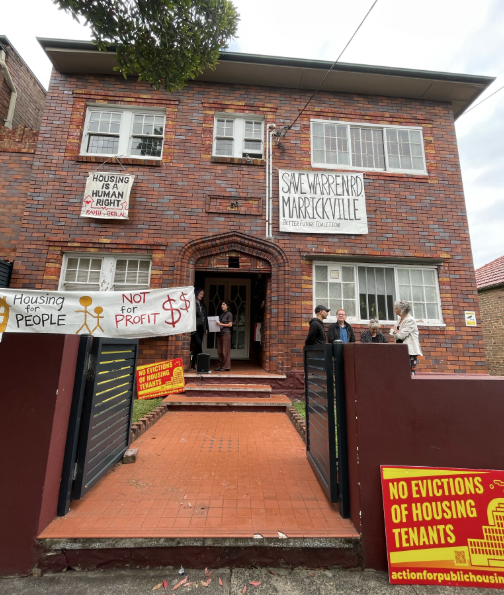
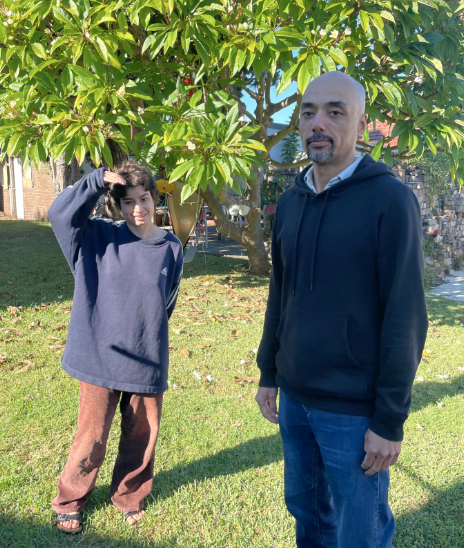
Warren Rd campaign; renters Erina and Duncan
One Warren Rd renter is Erina, a recent university graduate, whose north-facing studio on the first floor of 50 Warren Rd is the first stable home she’s had, after years spent moving between various sharehouses across the Inner West.
“When I moved in, I knew I really wanted to stay. I’ve been here for almost two years, the longest I’ve ever been in one place. Before that, I moved house nearly every year for seven years.”
Another renter living at the property is Duncan. A community activist in his forties, he moved into Warren Rd, nr 52, after his previous studio flat in Marrickville became unaffordable two years ago. It took him months to find his current home, which is the ideal combination of the right size, right location, and, importantly, the right price. The type of home he will not be able to find in the area again, not unless he is willing to pay much more or share amenities with other renters at the property.
“Ever since I found out about the development application, I have been perusing apps, looking at what the places are like out there, and it doesn’t look good. (...) The particular search I have is for anything under $425. In all of Marrickville, there might literally be one entry that falls in that price range. And they usually have a shared bathroom. Nothing like the standard I have now.”
The apartments in 50-52 Warren Road are a rarity not only because they are one of the last low-cost rentals in the area, but because they are one of the oldest. This pair of converted Victorian terraces, hidden behind a single brick facade from the 1930s, has been providing low-cost housing to local residents since the rapid industrialisation of Marrickville 100 years ago. Now, the private development plan by the owner proposes a “demolition of existing structures and construction of a nine (9) storey residential flat building, including three levels of basement, removal of eight (8) trees, and associated works”.
After initially feeling emotional and overwhelmed by the news of the proposed development, Erina thought that her neighbours must feel similarly distressed and decided to act. She wrote a letter detailing what the DA entailed for the building and distributed it among the residents, inviting them to meet that weekend to discuss what to do about the situation.
“At the time, I didn’t actually know what we could do, but I had four days until the meeting to figure it out,” she remembers “ As days went on, I worried nobody was going to come. I even door-knocked. And that’s how I met Duncan.”
Six or seven of Erina’s and Duncan’s neighbours showed up to the residents’ meeting in the backyard, and she was surprised by just how much appetite there was to collectively do something to save their homes.
She had prepared a simple guide on how to make a submission on the Council’s website to voice opposition to the Development Application.
In the process of educating herself on how to make a submission, Erina learnt that the last time the Warren Rd apartments were considered for redevelopment, the only submissions made to the Council were by the homeowners of surrounding properties. The renters, whose lives would be negatively impacted if the development went ahead, didn’t voice their opposition.
But times have changed, and the housing crisis has deepened since the last time the Council considered a Development application for 50-52 Warren Rd. Erina, motivated to save her and her neighbours' homes, created an easy-to-access link to the submission’s website on the Inner West Council page and provided a series of screenshots guiding users on how to make their own submission, as well as a bullet point list of tips on how to ensure it is an effective one. During the exposition period, the Council recorded 190 submissions opposing the redevelopment, 70 of which were considered “unique” (i.e., written without the use of templates or repeated arguments).
“We are quite lucky to have connected with one another at the DA stage, rather than at the point of eviction. We have time to come together and act.”
In the weeks following the DA consultation period, unsure what else she could do to help save their homes, Erina contacted Action for Public Housing, a community group previously involved in the campaign to save the Selwyn Street boarding house from closing and redevelopment in Darlinghurst.
She learnt that because the Council's planning team had not approved the DA’s current form, the developer had initiated a process of conciliation at the Land and Environment Court, and that’s where the residents would have another opportunity to advocate for the saving of their homes.
On the 22nd of April, on the steps outside the entrance to the apartments in Warren Rd, the Commissioner of the Land and Environment Court began the conciliation proceedings and opened the floor to oral statements.
Six people spoke about the various reasons why they thought the buildings and the small, low-rent apartments they house should be retained. Among them, Erina and Duncan described how this development would displace them from the area they have called home and disrupt their lives, throwing them back into the instability they managed to escape. A spokesperson for the Marrickville Heritage Society told the unique story of the buildings and their importance to the area's history. A message from an architect pointed out glaring issues with overshadowing, privacy concerns and layout faults in the design. The proposed redevelopment of the Warren Rd apartments has the potential to set a precedent for the type of development the Inner West Council will need to approve in line with its mission to deliver up to 31,000 new homes.
Under the Fairer Future Plan, which didn’t inform this current development, developers will be required to make “a 3% affordable housing contribution on all private development in the upzoned areas, with 20% required for any private planning proposal with additional floor space.” As part of the current DA, the owner of the two lots in 50-52 Warren Rd plans to erect a nine-story, 43-unit apartment block, estimated to cost $22 million and deliver eight ‘Affordable Housing’ units (7 only available for a period of 15 years). This is a 20% proportion of affordable housing, the higher end of what might eventuate in other buildings. On this block, if it proceeds as proposed, the development could see a net reduction of low and medium-income households in the area by nine. Only one of the affordable units will be a one-bedroom flat catering to the current renters in the building – the rest will be two or three bedrooms. The overall loss of low-cost housing would stand at 17, as the anticipated rents (even in the “affordable” units priced at 20% below market rent) would likely exceed the cost of rent now paid by the residents.
| Unaffordable affordable housing | |
| "Affordable" rents under the current guidelines - no more than 80% of median rent in Rent and Sales Report | |
| Studios: | $464 |
| 1 bed | $480 |
| 2 bed: | $600-$640* |
| 3 bed: | $840-$880* |
*Either the LGA or the postcode can be used
These Warren Road apartments illustrate an issue with ‘Affordable Housing’ as a program. There is planned just one one bedroom apartment, the other affordable housing units are two and three bedrooms. So one of the current residents at Warren Rd would need to find possibly an extra $5,000 a year to afford to stay – a big ask. But let’s imagine a family of 4 – two parents, two children who may need a bedroom each. A three bedroom apartment at $880 per week works out fairly affordably for a household income of $181,400, the top end of moderate income households. It takes up about 25% of their income – though it’s also worth noting that in the last year the allowed affordable housing rent level has jumped almost $100 per week from $792 to $880 and there’s no guarantee it won’t do the same over the next year.
It doesn’t work out nearly as well for a family on a more modest income – let’s say at the top of the ‘low income’ range of $121,000. This family earns $35,000 too much to be eligible to enter social housing, but a 3bedroom affordable housing unit at $880 takes up 38% of their income! They could squeeze into a 2 bedroom to get under 30%, but for many families this would place them into overcrowding which comes with a range of other costs.
The issue with Affordable Housing based on market discount is both that it moves with and is reliant on a market that does not respond well to the needs of the community. In just the last couple of weeks we’ve seen interesting reflections from researchers noting how this approach is not working. We recommend settling in for a good reading session of these two back to back!
Dominic Behrens and Ethan Gilbert: Against Affordable Housing
Hanie Khosravi, Alistair Sisson and Kristian Ruming: Affordable Housing in Australia: The Neoliberalisation of Subsidised Rental Housing (open source)
Inner West Council is currently running a consultation into their Affordable Housing policy, you can have your say at yoursay.innerwest.nsw.gov.au/draft-affordable-housing-policy
We believe genuinely affordable housing should respond first to the household’s income, and be available to very low, low and moderate income households – not only moderate incomes. That would mean it can be set at a level that ensures the household has enough left over after rent to meet their other needs. While 25% is a commonly accepted level for social housing, even that is too high for some given the extremely low levels of welfare support in Australia.
That doesn’t help the important work to “stop the exodus of young people and essential workers from the Inner West and make sure that in the decades to come our children and grandchildren can have a home in the community they love”.
Listening to Erina and Duncan talk about the stability and the sense of safety they found in Warren Rd makes me wonder why the government couldn’t purchase the two lots of self-contained flats to ensure the area maintains the diversity of dwelling and household types as prescribed by NSW planning regulation. With appropriate maintenance, the buildings are perfectly suitable to continue providing much needed low-cost accommodation for local teachers, nurses and other essential workers. It makes me wonder whether a modest investment could replace the disused garages at the back of the property with new single-story structures to accommodate additional units. Perhaps exploring these options could achieve more homes without the loss of heritage, compromising the shared garden space the residents cherish, and most importantly, without the displacement, financial precarity and personal turmoil the axing of these hard-to-come-by low-cost homes will cause.


