


Could a Human Rights Act transform renters rights in NSW?
24/03/2026 • Eloise Parrab

In late 2025 Greens MP Jenny Leong introduced a Human Rights Bill into NSW Parliament and over 120 organisations (including the Tenants’ Union) and individuals endorsed an open statement calling on all NSW Parliamentarians to support the establishment of a public enquiry into a Human Rights Act in NSW. This call also reflected the NSW Labor Party's platform at the last election where they committed to conducting a community consultation into legislation to better protect the human rights of residents in NSW.
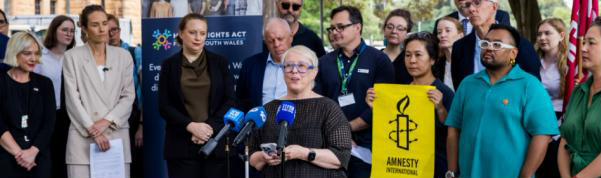
On Tuesday 17th March the Tenants’ Union joined other members of the Human Rights Act for NSW Alliance and Members of Parliament at a press conference behind NSW Parliament House. We collectively called upon Premier Minns to refer the Human Rights Bill to inquiry which would allow public consultation on the Bill. On Wednesday with unanimous support from the NSW Parliament the government referred the Bill and now everyone in NSW will have an opportunity to contribute to the inquiry.
Currently in Australia we do not have a Federal Human Rights Act and only three jurisdictions in Australia (ACT, QLD and VIC) have dedicated human rights legislation.
You might be asking yourself why we need a Human Rights Act….
A Human Rights Act would require our government to consider human rights when developing laws, policies and delivering services and it would also require Courts and Tribunal to consider human rights when making decisions. Without a specific Act there is no requirement for the government or Courts to consider our human rights in their decision making. Some human rights are contained in other pieces of legislation but not all are currently protected. For example a key human right is the right to adequate housing but this right is not legislated in NSW and therefore the government does not need to consider this important human right when it develops laws and policies in NSW.
A right to adequate housing is more than having a roof over your head or shelter. The International Covenant on Economic, Social and Cultural Rights (ICESCR) in Article 11 states:
"The States Parties to the present Covenant recognize the right of everyone to an adequate standard of living for himself and his family, including adequate food, clothing and housing, and to the continuous improvement of living conditions."
Key elements of the right to adequate housing
From the Special Rapporteur on the right to adequate housing
Adequate housing must provide more than four walls and a roof. A number of conditions must be met before particular forms of shelter can be considered to constitute “adequate housing.” These elements are just as fundamental as the basic supply and availability of housing. For housing to be adequate, it must, at a minimum, meet the following criteria:
- Security of tenure: Housing is not adequate if its occupants do not have a degree of tenure security which guarantees legal protection against forced evictions, harassment and other threats.
- Availability of services, materials, facilities and infrastructure: Housing is not adequate if its occupants do not have safe drinking water, adequate sanitation, energy for cooking, heating, lighting, food storage or refuse disposal.
- Affordability: Housing is not adequate if its cost threatens or compromises the occupants’ enjoyment of other human rights.
- Habitability: Housing is not adequate if it does not guarantee physical safety or provide adequate space, as well as protection against the cold, damp, heat, rain, wind, other threats to health and structural hazards.
- Accessibility: Housing is not adequate if the specific needs of disadvantaged and marginalized groups are not taken into account.
- Location: Housing is not adequate if it is cut off from employment opportunities, health-care services, schools, childcare centres and other social facilities, or if located in polluted or dangerous areas.
- Cultural adequacy: Housing is not adequate if it does not respect and take into account the expression of cultural identity.1
Currently in NSW our housing system is failing to meet the key elements. We no longer have no grounds terminations but the reasonable grounds and evidence requirements that commenced in May 2025 are not sufficient to protect renters from unfair evictions. We know that there is a housing crisis where rents are increasingly not affordable with no cap on rent increases. Renters make difficult decisions each day between buying food, medicine and paying rent or being pushed out of their communities because of insufficient homes in the locations they need. We heard from renters at the Renters Forums we ran in 2024 that their homes are too hot in summer and too cold in winter and the cost of running appliances to try and regulate the temperature is excessive and prohibitive. Habitability requirements in our tenancy legislation are minimal, and don't guarantee the availability of services and they also place heavy burden on the renter to take action if the landlord is not fulfilling their responsibilities. Discrimination continues to create barriers for renters when they are applying for homes and many homes are not suitable for a range of people with disabilities, nor are people provided the ability to modify to meet their needs. Both the application process for renting in NSW and the disability building standards need to be overhauled to ensure accessibility for all people in NSW. We know through the casework of the Tenants Advice and Advocacy Services that repairs are one of the most common issues for renters seeking advice. Our rental laws and housing system in NSW are not currently up to the job of addressing these key elements of the right to adequate housing. Australia has recognised that it has international obligations under the ICESCR but currently they are not contained in any law and therefore are not enforceable.
In other states and territories, community legal centres like the Tenants' Union have been able to run cases that start to show how a Human Rights Act can change the decisions. Human rights arguments have mostly been relevant in cases where the Government has been seeking to evict a social housing tenant. In the ACT there has been success and the Court has found that human rights legislation does give social housing tenants effective protection from arbitrary eviction. The ACT tribunal has affirmed that ‘The concept of proportionality is central to consideration of the application of the [HRAACT]’ to eviction proceedings. The tribunal also noted that ‘Human rights need to be considered … in most cases where there is an eviction’. In Victoria on the other hand there has been some success with social housing tenants raising human rights arguments in proceedings in the Supreme Court seeking a judicial review of a social housing provider's decision to seek termination. Currently human rights arguments have been found by the Court to not be possible in first instance eviction matters in Victoria’s Tribunal. This creates barriers for tenants as commencing Supreme Court proceedings is not as accessible as termination hearings at the Tribunal.2
Where a Human Rights Act has been implemented in some states and territories in Australia there have only been partial protection of the right to adequate housing. In Victoria the right to adequate housing is very limited as it has only been applied to public housing and therefore protects only small portions of the population. This is not a good precedent where different populations can be given different human rights, or that the government can apply the right only when it's convenient to do so such as applying it in public housing only where tenants arguably are already the most protected against arbitrary evictions and unaffordable rents. As outlined above it can only be used in Supreme Court proceedings and not at first instance Tribunal hearings. In Queensland the Human Rights Act does not specifically include a right to adequate housing - leading to that state refusing to end no grounds evictions in part because it would interfere with the human rights of landlords. In the ACT 20 years after their Human Rights Act commenced the Act was amended in late 2025 to include the right to adequate housing. This right will commence from January 2027.
These shortcomings and gaps highlight how important it is to get this right from the start. The Tenants Union is advocating for a Human Rights Act for NSW to include the right to adequate housing. If we have a right to adequate housing in NSW it does not mean that we have the right to be given a home or provided housing by the NSW government. For renters in NSW it would require the NSW Government when developing laws and policies that apply to renters to do so from within a human rights framework. It would also allow the NSW Civil and Administrative Tribunal and Courts hearing tenancy disputes to interpret legislation from within a human rights framework. The Tenants’ Union has been advocating for some time for housing to be considered an essential service and a right to adequate housing enshrined in a Human Rights Act would assist in framing housing in this way.
A recent reform to tenancy legislation in NSW was the removal of no grounds terminations and the implementation of specified grounds on which a landlord can issue a notice of termination. If we had a right to adequate housing in legislation in NSW then an example of applying a human rights framework when developing new termination grounds could involve giving the NSW Civil and Administrative Tribunal the ability to look at the tenants' circumstances and weigh this up against the landlord's circumstances when making a decision on whether to end a tenancy. At the moment there is no ability to consider the tenants' circumstances when NCAT is deciding on whether to make a termination order. A right to adequate housing enshrined in a Human Rights Act would enable NCAT to make their decisions through a human rights lens and apply discretion not to terminate where appropriate.
More details of the NSW Government consultation on a Human Rights Act will be shared when they become available.
"Our housing system needs all the help it can get at the moment. A human rights act which delivers on the right to adequate housing will make an enormous difference in protecting communities from unfair evictions, excessive rent prices and unhealthy homes. The premier state should lead the way in delivering the homes people need."
– Leo Patterson Ross, CEO, Tenants’ Union of NSW


