

RENT TRACKER
NEW RENTERS KIT

SUPPORT OUR WORK
Survey guide
The NSW Government has opened a consultation investigating Minimum Energy Efficiency Rental Standards (MEERS). This means they are asking renters, landlords, and the broader community to share their views on whether rental homes should be required to meet a basic level of energy efficiency.
You can have your say by completing the online survey or a short submission about your experience. The survey takes about 10-15 minutes and is an important chance for you to be heard.
This page is a guide to help you structure your responses to the online survey. The survey consists of mostly multiple choice questions, but there are a few sections where you can write longer questions. We’ve prepared information to make those multiple choice options easier, and also guidance for longer-form questions. Tap and open the sections below the button for our guidance on each survey question.
You can access the survey via energy.nsw.gov.au/meers or click the button below.
Your guide to completing the online survey
What are Minimum Energy Efficiency Rental Standards?
Minimum Energy Efficiency Rental Standards, or MEERS, are proposed standards that would require rental homes to meet a minimum standard for both thermal and energy performance.
In practice, this means rental homes should:
- Stay warmer in winter and cooler in summer,
- Be cheaper to heat and cool,
- Be healthier to live in,
- Use less energy overall.
What kinds of standards are being considered?
The government is looking at different ways to set these standards. The two main approaches they are considering are:
Features-based standards
This approach requires specific items to be installed in a rental home, for example:
- A heater or air conditioner,
- Ceiling insulation,
- Draught sealing.
A simple way to think about it is, “does this home have certain things installed?”.
Performance-based standards (also known as home energy rating)
This approach looks at how well the whole home performs, usually through a home energy rating system such as NatHERS. This is a similar system to what you might have seen on your home appliances such as your fridge or washing machine. Those star ratings can also be used to rate how well a home “performs” when it comes to energy use.
Homes are given a score based on their overall energy performance, including how efficiently the building is designed and built to maintain a comfortable indoor environment and minimise energy use.
A simple way to think about it is, “How well does this home perform as a whole?”
Comparing the two approaches
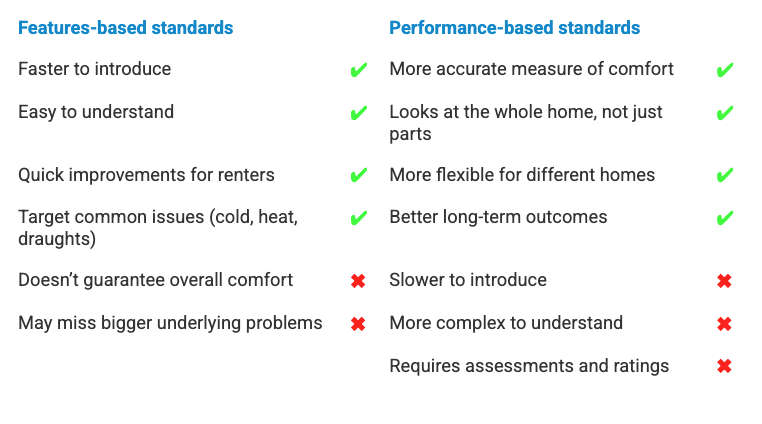
Below is a brief comparison between the two approaches.
Our preference: performance-based standards
We believe performance based standards are optimal and should be the north star for MEERS overall direction. This approach will provide the best outcome for renters, rental homes and have wider society benefits. It better reflects how homes actually perform and delivers long-term consistency and quality across the rental sector.
Within performance based standards there can be a staged approach. If there is a clear requirement to meet a home energy rating by a set date there can also be requirements along the way for certain features to be installed that assist the home in achieving the rating. This is important because it ensures that renters start to see improvements in comfort and affordability as the landlord works towards making the necessary changes to meet the home energy rating.
Improving both the thermal and energy efficiency of a home with features like draught sealing, ceiling insulation, and energy efficient reverse cycle air conditioning - we would see pretty quick improvements for renters.
Over time, homes would need to meet an overall energy performance rating. This is important because it ensures that homes actually perform well overall, it avoids a tick-box approach, and it supports long term improvements across all rental homes.
Next we’ll go through the survey in more detail including sections you can simply copy and paste. The sections that are not in [italics] are ready for you to copy and paste.
There are 7 questions in this section. They are simple questions getting to know who you are, if you’re a renter, where you’re based etc.
Question 1 and 2 of this section are multiple choice questions asking you to select up to 3 responses. If you want to write a longer response, you can select just 2 options and select OTHER and then in the OTHER box, you can write a longer response.
Question 3 of this section is a long-form response. This is one of the best opportunities in the survey to share your story and thoughts.
Please tell us about any experiences you have had with energy efficiency in rental homes.
You can share your own experience or experiences from your work, for example as a renter, landlord, real estate agent, tradesperson or in another role.
[This is where you will write the bulk of your personal story - we can’t help you too much but we have provided some guidance and a suggestion for how you can start this section.]
Everyone deserves to live in a healthy, affordable home. But this isn’t the case for many renters. Our/their homes are too cold in winter and too hot in summer. Renters are facing higher energy costs and indoor conditions that make us/them and our/their families sick.
[Sentence introducing yourself, e.g. “I am a renter in Sydney’s Inner West. I’ve been renting for my whole adult life, and now live in an apartment with my partner and our dog”.
Share your experience of renting a home which was not energy efficient and the impact on you. It's really important to paint a vivid picture here, we want the people reading your experiences to really understand them. You can talk about the impact sleepless nights have had on your work, your ability to perform caring duties, to study - or how you struggle over winter and being forced to choose between being cold or facing large energy bills. eg. “My house is very hot in summer. We have no air conditioner, no ceiling fans and no flyscreens. We often cannot sleep in our bedroom as it's too hot and have to sleep in the living room downstairs with a pedestal fan blowing hot air. I have asked the landlord if they can make some changes to make the house but they have said no.”
If you have friends of family members who have shared experiences with you, you can also share them here. For example:
“My daughter rents her home in Leichhardt, when it gets really hot she comes and stays at our house as we have air conditioning. She has said that she can’t cook during summer because it heats her home up too much so she often relies on take away food which gets really expensive.”]
[Below are some other things you could choose to include in your response to this question]
Everyone deserves to live in a healthy, affordable home. But this isn’t the case for many renters. Their homes are too cold in winter and too hot in summer. Renters are facing higher energy costs and indoor conditions that make them and their families sick.
24% of renters are unable to keep a comfortable indoor temperature in winter (double the number compared to owner-occupiers). 30% can’t stay cool in summer compared to 16% of homeowners. The gap is largest in lower income and regional areas.
Renters homes are generally poorer in quality and often in a poor state of repair. This failure by many landlords to maintain homes and undertake timely repairs means many renters are living with mould which can be made worse by poor energy efficiency.
We know that renters are forced to seek temporary refuge away from their homes during extreme weather conditions, heading to community centres, libraries or shopping centres.
Renters currently have little or no reliable information regarding the energy performance of their property. They have limited rights to make changes to improve the thermal and energy performance of their home.
A house that’s uncomfortable is not a place renters can relax and feel safe in. This continued discomfort, combined with the knowledge that there is little to no alternative to the situation they are in, leads to many renters feeling sad, angry and embarrassed by the conditions they are forced to live in.
Renters must live with the health and economic consequences, and face the threat of eviction or punitive rent rises if they raise issues with the property.
Home owners can reduce their own bills by investing in energy upgrades , while renters are less able to reduce their energy bills and more vulnerable to energy bill variations.
People on low incomes have fewer choices, and are living in housing that is the least efficient and often unfit to support their health and wellbeing.
Section 3 is only one question, it is a multiple choice question for you to select 3 options for what you think the biggest benefits of introducing MEERS are. If you want to write a longer form submission to this, you can just select 2 options and then select OTHER. In the OTHER box you can add any of the information below.
Information to add in a long form response
Introducing minimum energy efficiency standards for rental homes in New South Wales would lift the quality of rental homes and make them safer, more comfortable, healthier and cheaper to run.
The benefits of minimum energy efficiency standards for rentals are improved thermal comfort and minimising the energy consumption of rental homes to reduce energy bills and support the health and wellbeing of people who rent, as well as contribute to a zero-emissions energy sector.
Living in a rental home that is too hot in summer and too cold in winter can have significant impacts on both physical and mental health. Research shows that exposure to extreme temperatures can lead to a range of health issues, including heat-related illnesses such as heat exhaustion and heatstroke during hot weather, increased cardiovascular illness and disease, and respiratory problems and hypothermia during cold weather.
We know that renters spend more money on energy bills and are more likely to be in energy hardship. Implementing MEERS would have a direct benefit on renters energy costs and remove the need for renters to turn off heating or cooling to save money.
Nowadays, about 1 in 3 Australians rent, and many more people are renting long-term. People are retiring as renters, and more children are growing up in rental households. These people should have a decent home.
There are also wider society benefits beyond the individual benefits for renters. Improving the energy efficiency and performance of rental homes is critical to achieving NSW’s emissions reduction targets and broader climate goals.
Section four includes 2 questions that focus mostly on the challenges facing landlords and real estate agents.
Question 1 in this section:
The first is a multiple choice question where you can select the top 3 challenges you see. You can also select “no challenges” or “not sure” or if you want to write a longer answer, including the challenges to renters if the standards are not introduced with protections for renters, you can select OTHER and put in some of the information below.
Info to add in a long form response
The outcome of minimum energy efficiency standards must be that the renter is better off.
Clear and accessible information must be available to make this a smooth transition. Establishing one-stop-shops for energy upgrades, providing advice, finance options, and access to tradespeople will help provide clarity and reduce misinformation.
Implementing MEERS will require a clear phased introduction. This will allow landlords time to access information, plan and budget for work that is required. A phased introduction will also allow industry time to prepare for additional workloads in the sector.
Compliance mechanisms cannot be reliant upon renters and should not place additional responsibility on the renter. Currently too much responsibility is placed on renters to take action when landlords are not complying with their legal obligations. Renters should not be responsible for ensuring landlords are appropriately complying with minimum energy efficiency standards.
Renters should be protected from excessive rent increases that are given in response to landlords compliance with any new standards. In particular, this should apply to any rental properties where the owner received a subsidy or financial incentive to reduce their compliance costs.
Renters must be protected against retaliatory evictions if they pursue their landlord for compensation for failure to comply or dispute an excessive rent increase. Renters should not have their tenancy agreement ended on the grounds the landlord is undertaking work to comply with new minimum standards.
Property investors already receive generous tax concessions and incentives as part of owning a rental property, and therefore additional incentives should be carefully considered.
Governments could introduce incentives to support more ambitious standards and encourage compliance. Such incentives should be targeted and equitable and not disproportionately benefit higher income earners.
Question 2 in this section:
Question 2 in this section is another multiple choice question asking what support should be given to landlords where you can select your top 3 responses. You do have the option to write “not sure” or OTHER. If you want to write a longer response you can select OTHER and write it in there.
Question 1 of this section:
Question 1 of this section is asking if there are variations that should be allowed to make MEERS different in different housing types. We do not believe that there should be variations and that standards should be applicable to all housing types.
Mandatory minimum energy efficiency standards should apply to all rental properties, including:
- Apartments, houses, granny flats and villas
- private residential rental
- public housing
- community housing, including Aboriginal and Torres Strait Islander housing
- boarding and rooming houses
- Build to rent
- Affordable housing
- Short term rentals
- land lease communities, including residential parks, mobile homes
- premises on the campus of or owned by educational institutions
- employer provided housing
- retirement villages
- aged care accommodation
- transitional and emergency accommodation
Public and community housing, caravan and residential park accommodation,
specialist disability accommodation, boarding or rooming houses, nursing homes, and retirement villages are home to some of the more vulnerable members of our society, who would benefit the most from energy efficiency reforms. Lengthy delays or lowering the requirements in implementing the standards for these rental properties should be avoided.
Question 2 of this section
Question 2 of this section is asking if the standards should vary by region across NSW. We believe the requirements should be the same across NSW.
Question 1 of this section
Question 1 of this section is asking you what approach should be taken to implement MEERS. This is where it is asking about features-based or performance-based standards. Our preferred approach is option 2 which is performance-based standards.
Option 2: Home Energy Rating (NaTHERS) approach
Question 2 of this section
Question 2 of this section is asking you to explain why you selected this option.
Info to add in a long form response
A home energy rating approach will provide the best outcome for renters, rental homes and have wider society benefits. It better reflects how homes actually perform and delivers long-term consistency and quality across the rental sector. It allows landlords to be responsive to climate and building variations and therefore more flexibility on how they meet the standard. This approach will make ensuring compliance with the standards easier as there will be an independent third party assessment of the home.
Within performance based standards there can be a staged approach. If there is a clear requirement to meet a home energy rating by a set date there can also be requirements along the way for certain features to be installed that assist the home in achieving the rating. This is important because it ensures that renters start to see improvements in comfort and affordability as the landlord works towards making the necessary changes to meet the home energy rating.
There is only one question in this section, it’s asking if you have any personal experiences or observations of other jurisdictions or countries with MEERS.
Info to add in a long form response
Minimum standards have been implemented successfully internationally for decades and more recently in other jurisdictions, including Victoria, the ACT, the UK. The evidence shows there’s no adverse impacts on rental supply. Research in ACT and the UK have found no measurable impact on rental prices.
[Option to include your own experiences with living in another jurisdiction with these standards. It will be helpful to provide details about how this impacted on your experience as a renter. What it meant for your daily life]
There are 2 questions in this section.
Question 1 of this section
Question one is a simple question asking you to pick if you strongly support the introduction of MEERS in NSW. We hope you select “Strongly support”.
Question 2 of this section
Question 2 is asking you to explain why you support or oppose MEERS.
THIS IS THE LAST QUESTION OF THE SURVEY
Info to add in a long form response
I strongly support the introduction of mandatory minimum energy efficiency standards in NSW.
It will help me/us/renters to live in a more comfortable environment, reduce my/our/their energy bills and lower my/our/their environmental impact.
[Option to include how you think it will personally benefit you and your family and/or benefit other renters you know. Tell the government why it's important to you]
RENT TRACKER
NEW RENTERS KIT