




Home Owner Appeals at NCAT on their Right to Site Dimensions and for a Community Map
01/09/2026
From time to time a decision at the NSW Civil and Administrative Tribunal (NCAT) is published where the application for orders has legal merit to succeed but the justice that was sought doesn’t prevail in the first instance.
In one such decision Wass v Conaught Pty Ltd [2025] NSWCATCD 225, heard on 9 October 2025, the home owner (Wass), applied for several orders including an order determining their site dimensions and an amendment to their site agreement to record them. Wass also, sought an order for a map of the community (to-scale) to be displayed. The Tribunal heard the matter and reserved its decision. When the decision was handed down on 22 December 2025, all the orders sought were dismissed.
In late May 2026 we were in contact with Wass who informed us they’d appealed the decision, and wanted to share their success with other home owners to highlight some of the rights they have.
NCAT’s decision in the first instance
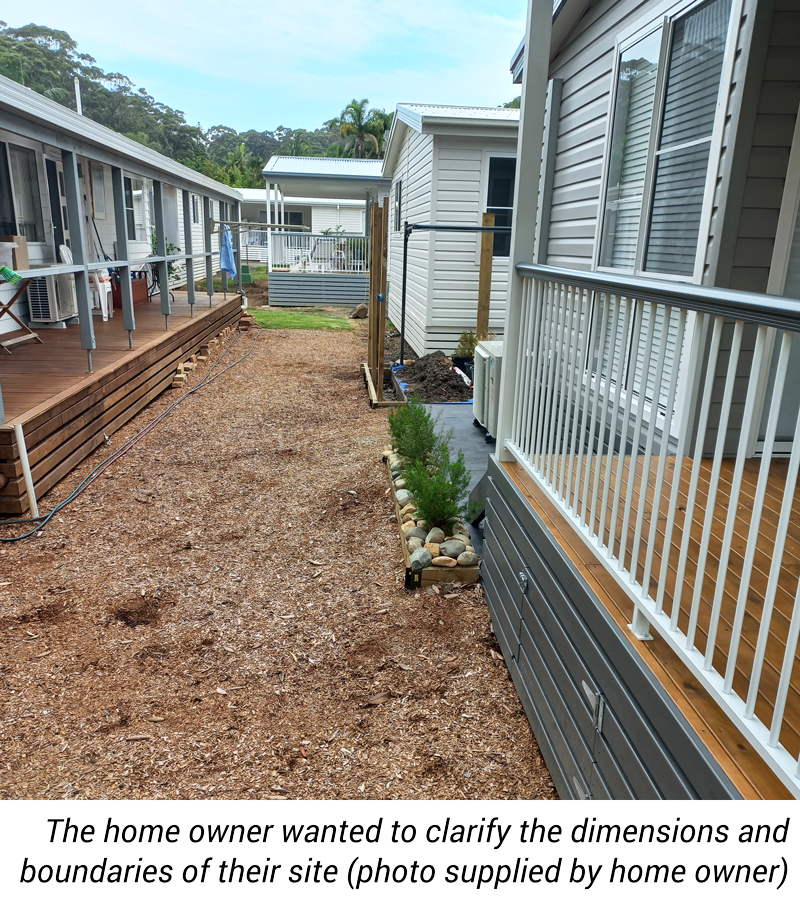
The original decision notes that Wass purchased a home and moved into The Palms at Avoca located on the Central Coast of NSW in the second half of 2013. They did not know their site boundaries or dimensions in any exact terms, and this had become more important as preparations began for the installation of new homes on sites located to the western and southern boundaries of their home. The uncertainty about site boundaries contributed to some tensions between residents in the community which may have been avoided if the operator had complied with its statutory obligations.
In the published decision issued December 2025, it was clear the Tribunal had considered sections 26(2)(a) of the Residential (Land Lease) Communities Act 2013 (RLLC Act) which states a site agreement must identify the residential site by its number and its dimensions and also section 37(1)(j) which requires an operator to comply with all statutory obligations relating to the community.
The Tribunal also acknowledged that section 13(3) of the RLLC Act states "nothing in this Act limits any requirement imposed by or under the Local Government Act 1993 or the Environmental Planning and Assessment Act 1979."
NCAT's written decision acknowledged that this would include provisions within the Local Government (Manufactured Home Estates, Caravan Parks, Camping Grounds and Moveable Dwellings) Regulation.
In those regulations the definition of a ‘community map’ requires it to be to-scale and in clause 125 of the same regulation, the operator must ensure a community map is placed in a prominent position in a caravan park as specified in the approval to operate document for the community.
Contrary to those legal references made in the decision, the Tribunal concluded there was insufficient evidence that Wass’ site dimensions were incorrect and dismissed that portion of their application. Wass had included an order for their site agreement to be amended to state their site dimensions as per section 26(2)(a) of the RLLC Act but this component of their application was not addressed.
In addition, the Tribunal (incorrectly) determined that the community was a manufactured home estate and not a caravan park without stating how it had made that finding. On this basis the Tribunal concluded that the operator did not have to ‘display’ a to-scale map in a prominent position as per clause 125(2) of the Local Government (Manufactured Home Estates,Caravan Parks, Camping Grounds and Moveable Dwellings) Regulation 2021).
That portion of the application was also dismissed without addressing that a home owner has a right to access a ‘to-scale’ community map from the operator.
The Appeal Decision
The NCAT appeal panel’s decision is not published but the outcome was shared with us.
The appeal panel consisted of Principal Member De Jersey and Senior Member Goldstein who made the following orders on 18 May 2026:
The Respondent comply with s26(2) of the RLLC Act to identify the dimensions of the site either by amendment of the site agreement or by letter amending the site agreement.
The Respondent display a community map as defined in clause 4 and of the Local Government (Manufactured Home Estates, Caravan Parks, Camping Grounds and Moveable Dwellings) Regulation 2021 and in accordance with s125(2) of the same regulation.
Wass attributes their success with the appeal application and appeal hearing to the benefit of their years of working as an educator. Wass shares their win as a reminder to home owners about the existing rights they have to know their site dimensions and to have access to an up to date and to-scale community map.
The rights of home owners in land lease communities
The importance of knowing your site dimensions and having access to a map of the community that is to scale is protective and could be relevant in a range of situations including:
- To avoid neighbour disputes about site boundaries
- To seek the operator’s written permission to make a compliant addition to the site or home
- To facilitate a smooth process during the sale of homes on site
- For affected home owners to understand their rights around a development application or other planning proposals for a new facility or service in the community
Under section 26(2)(a) of the Residential (Land Lease) Communities Act all home owners are entitled to have information recorded in their site agreement about the dimensions of their site.
All residents in a caravan park or a manufactured home estate are entitled to have access to the community map, which must be to scale.
For residents in manufactured home estates a map that is to scale must accurately show the road reserves, community amenities and dwelling sites within the community.
For residents in a caravan park a map that is to scale must show the access roads, community amenities and dimensions of the dwelling sites or camp sites and the designated off-site parking space for an occupant of a dwelling site or camp site.
The obligation to provide access to the community map is on the person who holds an approval to operate the community (typically the operator). The method of access varies slightly for the two types of communities but nonetheless residents in both types of communities have access rights to their community’s map.
More info
For more information, see also our Factsheet: Local Government Act & Regulations – approvals and maps.