



Land lease community home owner seeks action on nuisance fairy in the garden
01/05/2026
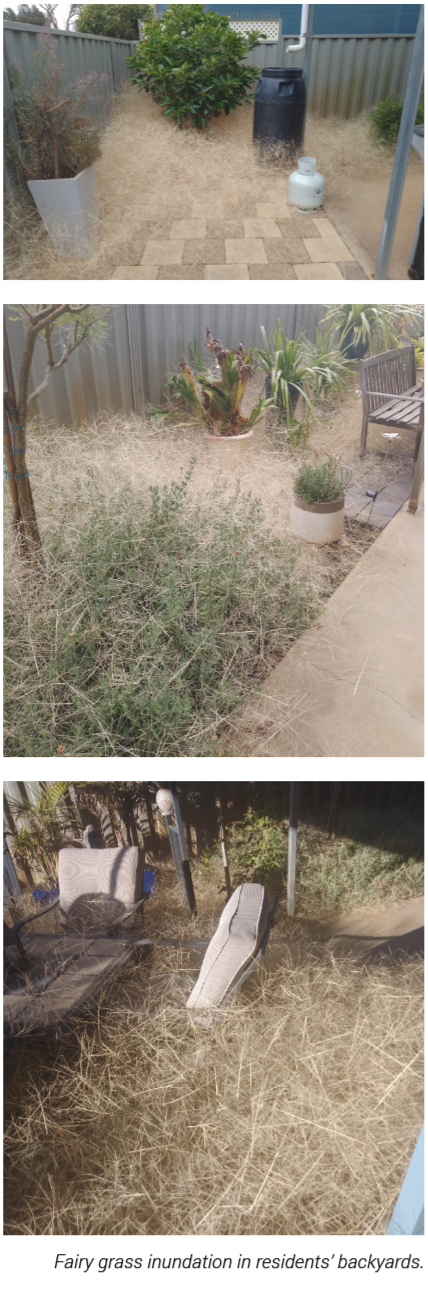
We were recently contacted by a home owner who lives in an over 50’s community on the NSW side of the picturesque Murray River. The community is generally neat and tidy, complementary to its natural surroundings. However in the spring months some residents’ homes are inundated with an astounding amount of fairy grass.
There are several holiday parks and land lease communities on both sides of the river bordering NSW and VIC as well as land used for agriculture or otherwise undeveloped but privately owned.
Just one row of homes on the west facing side of the community is inundated with the fairy grass each spring as a result of unslashed privately owned lots adjacent to it. The fairy grass blows in with seasonally high speed winds and is easily carried over the top of roofs and fences. At its worst it has piled up to the top of people’s roller doors. The simplest solution to the issue would be to ensure slashing of vacant lots occurs earlier.
In 2025 the home owner we spoke with was inundated by three separate ‘dumps’ between the 11th November and 15th of November. The dry weed covered their outdoor furniture, garden beds and paved areas rendering the backyard unusable for over 30 days.
It’s an issue that has been occurring annually since the community opened 16 years ago and many affected home owners are now too elderly to self manage it. If left unmanaged it can also create a fire hazard.
The home owner had approached the on-site managers to take some action on the issue but they claimed there was nothing they could do about it. Further discussions were then had with the area assets manager who came out to see the home owner in early December 2025 but subsequently never returned with a reply.
The home owner then lodged a written complaint with the local council and was visited by the Mayor on the 12th December 2025. He returned on the weekend to personally take care of the issue himself bringing bins and some sheeting. The dry weed material was wet down, compressed and cleared within three hours.
It is understood that the local council has since held meetings about the possibility of earlier slashing of paddocks to prevent this happening in the future. Prior to speaking with the Tenants’ Union of NSW, the home owner had also lodged an application for compensation at the NSW Civil and Administrative Tribunal (NCAT) due to the operator being unresponsive and the impact on enjoying the use of their site was too great.
Unfortunately, their two packages of documents filed with the registry were not provided to the NCAT member at the time of the initial hearing. The homeowner, discouraged by this turn of events, withdrew their application and has lodged a separate complaint with NCAT about the registry bungle.
How the Residential (Land Lease) Communities Act 2013 Assists with Weeds
Section 37(1)(g) of the Residential Land Lease Communities Act 2013 makes it clear that the operator has an obligation to take reasonable steps to keep the community’s common areas reasonably free of weeds and vermin.
In the reported example the weeds were did not originate nor travel from the common areas of the community and therefore it is thought that the home owner could rely on other sections of the RLLC Act 2013 such as the following:
37 Operator’s responsibilities
(1) The operator of a community has the following responsibilities—
(a) to ensure that the community is reasonably safe and secure,
If the community is located in a high fire risk area the operator should take steps to ensure that the community is reasonably safe. This ought to include taking any reasonable steps to minimise fire risks which could include liaising with neighbouring properties and council about managing hazards in the area
38 Right to quiet enjoyment
(1) The operator of a community must not unreasonably restrict or interfere with, or permit any unreasonable restriction or interference with, a home owner’s privacy, peace and quiet, or proper use and enjoyment of the residential site and the community’s common areas.
Maximum penalty—10 penalty units.
(2) The Tribunal may, on application by a home owner, make an order resolving a dispute concerning an operator’s compliance with this section.
It is arguable that the operator may be permitting unreasonable interference with a home owner’s right to proper use and enjoyment of their site if they have not attempted to engage with neighbouring properties or the council about the weed issue affecting the reasonable right to proper use and enjoyment of their site.
Local Councils can hold Land Owners Responsible for Weed Control
In NSW Local Councils are able to intervene in matters under their jurisdiction in accordance with the NSW Biosecurity Act 2015. Each council will have their own determination of ‘priority weeds’ formerly known as ‘noxious weeds’ and may also be able to address issues relating to other weeds which create a fire hazard or other safety risks.
Inspections of private land; risk assessments; education; allowing voluntary compliance; or otherwise taking formal enforcement action is all within the scope of what local councils are able to do utilising the Biosecurity Act 2015 and their order making powers under the Local Government Act 1993.